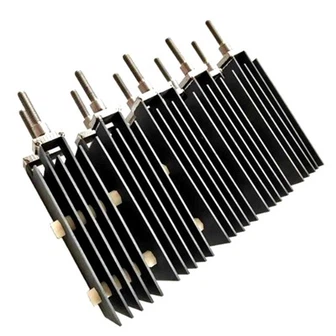
Overview of Titanium Anode Types
There are several types of titanium anodes to consider. Each type has its unique characteristics and applications.
Mixed Metal Oxide (MMO) Anodes
MMO anodes are among the most commonly used types of titanium anodes. They are characterized by a thin coating of mixed metal oxides, which significantly enhances their durability and resistance to corrosion. Owing to these properties, MMO anodes are extensively used across various industries, including water treatment, electroplating, and chemical processing.
Platinum-Coated Titanium Anodes
Platinized titanium anodes are known for their outstanding electrochemical properties and stability. They are especially effective in high-performance electrocatalysis applications, such as electrolysis and electroplating processes.
Ruthenium-Iridium Oxide (Ru-IrO2) Anodes
Ru-IrO2 anodes stand out for their exceptional stability and resistance to corrosion. They are prominently used in demanding environments, especially in the chlor-alkali industry, where long-term durability is crucial.
Iridium-Tantalum Oxide (Iri-Ta) Anodes
Iri-Ta anodes are acclaimed for their remarkable stability and excellent corrosion resistance. Like Ru-IrO2 anodes, they are often used in demanding conditions in the chlor-alkali industry. Their superior performance in harsh environments makes Iri-Ta anodes an ideal choice for industries seeking resilience and an extended lifespan.
Lead Dioxide Anodes
Lead dioxide anodes, also known as PbO2 anodes, feature a lead dioxide coating on titanium. This coating grants them excellent electrochemical properties and enhanced corrosion resistance. They are particularly effective in strongly acidic conditions, making them ideal for applications in electroplating, metal recovery, and certain wastewater treatments.
Here's a comparison table highlighting the key differences between MMO Anodes and Titanium Anodes:
|
Aspect |
MMO Anodes |
Titanium Anodes |
|
Coating |
Mixed metal oxides (e.g., ruthenium, iridium, platinum) |
None (Uncoated) |
|
Electrocatalytic Activity |
High |
Limited |
|
Corrosion Resistance |
Superior due to the mixed metal oxide coating |
Good, inherent to titanium |
|
Applications |
Electrolytic production, cathodic protection, sewage treatment |
Primarily water treatment, metal plating, and corrosion protection |
|
Price Point |
Generally higher, attributed to the specialized coating |
Typically lower, given the absence of any specialized coating |
How to Select a Suitable Titanium Anode?
Here are the factors to carefully evaluate:
1. Understand Application Requirements:
Operating Conditions: Consider the temperature, pressure, and pH levels in your application. Ensure the anode material and coating are compatible with these conditions.
Electrolyte Composition: Identify the components of the electrolyte. Some substances may be more aggressive or require specific coatings on the anode.
Current Density: Know the current density of your application. It's crucial for determining the required surface area of the anode and its coating thickness.
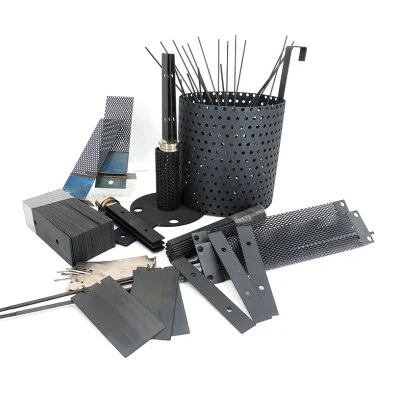
2. Choose the Right Anode Configuration:
Mesh: Offers high surface area, suitable for applications requiring uniform current distribution.
Rod: Good for applications with limited space.
Ribbon: Can be used for applications requiring flexibility.
Tubular: Offers robust structure, often used in harsh conditions.
3. Assess Corrosion Resistance:
Environment: Analyze the corrosiveness of the environment in which the anode will operate.
Coatings: Consider MMO or platinum coatings for additional protection. Ensure the coating is uniform and defect-free.
4. Evaluate Electrochemical Properties:
Electrocatalytic Activity: Needed for applications like water treatment or electroplating. MMO and platinum coatings enhance this property.
Voltage Characteristics: Ensure the anode has the right voltage characteristics for your application.
5. Determine Durability and Lifespan:
Material Thickness: Thicker anodes generally have a longer lifespan.
Operating Conditions: Harsher conditions may require more durable materials or coatings.
Maintenance: Understand the maintenance requirements to ensure longevity.
6. Check Quality and Certification:
Certifications: Look for industry certifications that guarantee the anode meets certain quality standards.
Supplier Reputation: Ensure the supplier has a good track record and can provide quality documentation.