

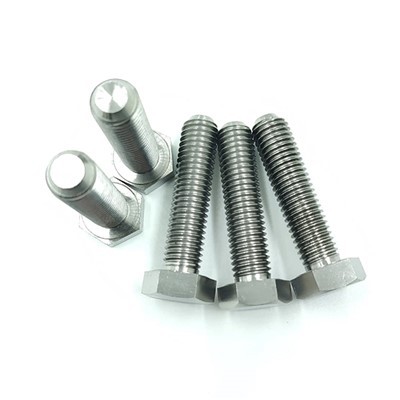
Titanium fasteners are made from titanium, a strong and corrosion-resistant metal, and are used in a variety of applications. Titanium fasteners are lightweight, durable, and can withstand higher temperatures than other metals.


Why Choose Us
Advanced Equipment
Equipped with melting, forging, stamping, slitting, machining & CNC, we provide processes for the final products.
Rich Experience
With more than 20 years of experience, we achieve prosperity with our clients together.
Quality Control
From VIM to products, we control our quality from the ores.
One-stop Solution
More than 3,000 tons in inventory, and we deliver to our clients promptly.
What Are the Benefits and Applications of Titanium Fasteners?
Fasteners and fixings need to be effective, and sometimes their appearance isn't so important, particularly when they are used on industrial applications or where they are hidden from view. Titanium is a shiny silver metal that is guaranteed to stand out from a distance and provide a quality aesthetic appearance for longer. Not only that, its low-density properties, high-temperature resistance and excellent corrosion resistance make it a popular choice for a range of applications.
Applications for Titanium Fasteners
Titanium has a high strength-to-weight ratio, is strong and relatively ductile, with a high melting point, making it useful in applications that could involve high temperatures.
The strength and low weight of Titanium make it exceptionally unique, and some grades of Titanium can be anywhere from two to four times stronger than Stainless Steel. These features make Titanium ideal in some aerospace, medical and military applications.
Titanium Fasteners are resistant to saltwater, making them suitable for use in maritime applications. They are also resistant to almost every chlorine or chloride solution, including chlorite, hypochlorite, chlorate, perchlorate and chlorine dioxide. If the chlorine is used with the absence of water though, or as a gas, this can cause rapid corrosion.
Titanium screws and fixings are used in applications where a high strength to weight ratio, excellent resistance to stress corrosion cracking and high corrosion resistance are needed.
A point to note: Whilst Titanium has excellent chloride resistance, it reacts badly to strong acids like hydrochloric acid or sulfuric acid, which attack the protective passive layer that Titanium forms when exposed to oxygen. This can cause corrosion.
Types of Titanium Used in Fasteners and Fixings
We usually stock fasteners made from Grade 2 or Grade 5 Titanium.
Titanium Grade 2 is an unalloyed titanium, classed as "commercially pure". This is widely used in industrial applications due to its moderate strength, excellent aqueous corrosion resistance and formability.
Titanium Grade 5 is alloyed with 6% Aluminum and 4% Vanadium. Grade 5 Titanium fasteners can withstand temperatures over 400 degrees C. and are exceptionally strong – often used in maritime and Aerospace applications.

Titanium fasteners have become extensively used across many industries over the last few years. The material is very active, flexible/high plasticity, and offers a fantastic combination of strength plus corrosion, oxidation, heat, and cold resistance; it is non-magnetic, non-toxic, and lightweight. It provides a low coefficient of thermal expansion and is not prone to embrittlement at extremely low temperatures.
How are these benefits for a screw?
Strength-to-weight ratio: The material's density is 4.51g/cm3, higher than aluminum and lower than copper, nickel, or steel. Titanium is impressively and uniquely strong as it is also extraordinarily light. Fasteners created from titanium can be four times stronger than 316 stainless steel but at about half the weight, depending on the grade used.
High Resistances: Titanium offers unparalleled resistance in many harsh environments. It is resistant to rapidly moving or stagnant water and temperatures as low as -320°F or up to 500°F. The material is practically inert to chlorine or chlorine solutions.
Other attractive properties: The material is non-toxic, non-magnetic, and biocompatible.
One of the most notable attributes of titanium fasteners is their superior resistance to sea or salt water. Over decades of use, it has been proven that titanium will resist even the most polluted water, can be used in applications up to a mile below the sea's surface, will withstand rapid currents and high velocity, and is not affected by sulfides.
The material can rapidly regenerate its protective passive layer in the presence of oxygen. This unique quality makes it extremely resistant to chlorates, chlorites, oxidation, hypochlorites (bleach), perchlorates, sodium chlorite, and chlorine dioxide; as long as moisture is present.
What types of fasteners are made from titanium?
A wide variety of screws, bolts, studs, rods, hex and lock nuts, washers, clamps, and more are made from titanium.
What grades of titanium are used for fasteners?
There are many grades of titanium used to create fasteners; however, the main three are grades 2, 5, and 7. Why?
|
Grade 2 |
Grade 5 |
Grade 7 |
|
2x stronger than 316 stainless steel, commercially pure, and most commonly used to manufacture fasteners |
2x stronger than grade 2, a true "workhorse" alloy with superior strength-to-weight and corrosion resistance |
Most corrosion-resistant titanium alloy, adds 0.12-0.25% palladium |
Do's and Don'ts of Titanium Fasteners
Titanium is an amazing material offering strength, lightness of weight, and corrosion resistance but there are also instances that titanium should not be used. This brief newsletter covers the do's and don'ts of titanium screws.
Do Use for Saltwater & Chloride Resistance
One of the most noteworthy uses of titanium screws is in saltwater environments. Naval as well as industries like desalination and offshore oil rely on titanium for their unparalleled resistance to saltwater. Titanium fasteners are resistant to both rapid moving and stagnant seawater up to a mile deep – even at temperatures of up to 500°F.
Like seawater, titanium screws are also almost inert to all chloride and chlorine solutions. This is due to titanium's ability to rapidly regenerate its protective passive layer in the presence of oxygen. Titanium fasteners are also resistant to:
• Chlorite
• Hypochlorite (Bleach)
• Chlorate
• Perchlorate
• Chlorine dioxide
Do Use for Strength and Lightness
Titanium grade 5 offers industry impressive strength: 148 ksi UTS and 138 ksi yield. What makes titanium's strength truly unique is that it is also extraordinarily light. Grade 5 fasteners are 4 times stronger than 316 stainless steel at nearly half the weight. (Grade 2 titanium is approximately 2 times stronger.) This unparalleled strength-to-weight ratio make titanium ideal for medical, aerospace, and military applications.
Don't Use in Acids
Titanium fasteners offer excellent corrosion resistance to salt water and chlorides but NOT strong acids. When exposed to acids like sulfuric (H2SO4), hydrochloric (HCl), their protective passive layer is attacked and can rapidly corrode in the right concentrations and temperatures.
Don't Use in Dry Chlorine
Though titanium screws are ideal for almost all chloride and chlorine applications they cannot be used in the absence of water. Dry chlorine and chlorine gases will make them rapidly corrode and even ignite. Typically 1% moisture (at room temperature) and 1.5% (at high temperature) is sufficient for titanium to regenerate its passive layer and remain resistant.
Additional Uses and Benefits of Titanium
In addition to its high strength-weight ratio, and saltwater and chloride resistance titanium also offers industry:
Non-toxic, biocompatibility and osteointegration, making it ideal for medical and dental applicationsTitanium Grade 5 fasteners are non-ferromagnetic.
Titanium Fastener Grades Explained
Some of the new age fasteners such as titanium hex head cap screws and titanium hex tap bolts are becoming increasingly important in the manufacture and assembly of products that have high performance standards. If you are in a position where you need to use any titanium fasteners, it might at first seem simple to pick one.
However, the truth of the matter is that there are so many different types and grades of titanium available, and you need to be careful with which one you pick. The primary difference between each type is that they have been slightly modified and alloyed with other materials to make them have specific qualities.
You would need to figure out the environment in which you intend to use your fasteners, and then pick a type that has been designed for your specific scenario. In some cases, you can even have them custom made. Out of the more than 40 varieties of fasteners out there, some of the most common of these include:
Grade 2 titanium
This is one of the most common types of titanium, and is considered to be a workhorse in the fastener industry. Grade 2 titanium is also known as commercial pure titanium, owing to the fact that it contains 99% titanium. Some of the instances where grade 2 titanium fasteners would be ideal include in instances where you need very good corrosion resistance such as in environments with a lot of salt water and brine. In addition to that, they are also extremely resistant to other chemicals including chlorides, acid solutions and reducing acids. The fact that it’s also very light and low density also makes it ideal for use in instances where weight has to be minimized.
Grade 5 titanium
Grade 5 titanium has been modified to give it extra strength. It comprises around 4% vanadium, 6% aluminum and 90% titanium. The result is that it has twice the strength and half the weight of comparable steel fasteners. However, it maintains the corrosion properties of Grade 2 titanium, which means that it can be used in all the environments mentioned above.
Grade 7 titanium
Grade 7 titanium is not as commonly used as the two above. However, it is still quite common in the fastening industry, since it has increased resistance against corrosion. This is on account of the fact that it has 0.15% palladium alloyed with it. The palladium dramatically increases the initially excellent corrosion resistance that pure titanium has, which makes it ideal for use in areas where the risk of chemical corrosion are extremely high.
Grade 23 titanium
This is a type of titanium that has been created with improved mechanical properties even at cryogenic temperatures. It is less likely to suffer from fatigue and to crack, which makes grade 23 fasteners ideal for fastening equipment that is likely to be used in such environments.
The next time you are shopping for titanium fasteners, you should remember that there are many different types to choose from. Simply figure out the environment you will use them in, and then choose a fastener that can cope.
What Is Titanium Grade 5?
Titanium Grade 5 (Ti6Al-4V) is a titanium alloy containing 6% aluminium and 4% vanadium and is regularly chosen due to its excellent formability, weldability and ductility.
Combining Titanium with other metallic elements, such as those mentioned above, makes it significantly stronger than pure titanium (Grade 1) and Grade 2 titanium (commercially pure).
With incredible strength, high impact toughness and superb strength-to-weight ratio, Titanium Grade 5 is the most popular and widely used titanium alloy across the world.
Another beneficial attribute of Grade 5 Titanium is its corrosion resistance. Like other titanium alloys such as Grade 2 and Grade 7 Titanium, Grade 5 Titanium is resistant to most chemicals and salt water. That, in addition to its strength makes it an ideal material choice for many applications.
Grade 5 Titanium Screws, Nuts & WashersTitanium Grade 5 is often used in applications which require high strength, low weight and strong corrosion resistance.
Therefore, components made of this material will often be found in industries such as medical, marine, aerospace and chemical processing where these qualities are essential.
Titanium Socket Cap Screws tend to be used in medical applications such as bone replacement, biomedical implants and dental implants.
Titanium Washers are another type of component regularly used in the medical industry for instruments and prosthetics.
Being stronger and lighter than steel, they are also a popular choice for aircraft assemblies where they can be used for jet engines, fan blades, landing gear and more.
Titanium Hex Nuts are also ideal for the industries mentioned above. Due to their general and salt water corrosion resistance, they can be a great component for assemblies in offshore tubulars within the oil and gas industry or, due to their lightweight strength, they also work well in sporting equipment.
Titanium Fasteners vs High Tensile Steel Fasteners
Titanium Fasteners Are Commonly Used In Wind TurbinesWhen people think of Bolts, more often than not they will generally think of a Steel Bolt.
Different grades of steel offer varying levels of tensile strength - the maximum amount of pressure or stress that the bolt is able to withstand before failing.
Simply put, high-stress applications require fasteners with higher tensile strength ratings.
8.8 Steel Bolts are commonly known as 'structural grade bolts' given their frequent use in bolted joints. Other common use cases for this grade of steel bolts are in the manufacturing of motor engines, railroad equipment and bridges.
High Tensile Bolts are typically used for high-stress fastening applications, often being used in the assembly of renewable energy solutions such as wind turbines. Trains, industrial machinery and automotive applications are also common places to find these components.
High Tensile Steel is known for its high machinability, strength and temperature resistance. Combined with its lower cost and excellent durability, it's a popular material choice for a diverse range of industrial applications, being the most widely used metal in manufacturing, automotive and infrastructure.
Titanium Fasteners vs Stainless Steel Fasteners
As a multi-purpose metal, it is highly versatile and its shiny appearance is as a result of the same element which gives this material its 'rust-free' quality; chromium.
Stainless Steel fasteners are increasingly popular in the marine and food industries, owing to their improved resistance to corrosion, chemicals and liquids, along with good machinability.
The most obvious advantage of using Grade 5 Titanium Screws over Stainless Steel Screws is the fact that this material offers a higher standard tensile strength, whilst also affording comparable corrosion resistance to 316 grade Marine Stainless Steel, also known A4.
However, similar to the issue of cost vs performance when choosing between Titanium bolts and Steel bolts, opting for Titanium over Stainless Steel will generally result in a higher unit cost, making it a more premium option.
Why Choose Titanium Fasteners?
Dress Up Bolts Are Often Titanium Bolts Used For Their Visual AppealTitanium is the superior choice for medium-high stress applications, where weight is a concern.
Motorsport is a primary use case for this, particularly in motocross, where large bolts such as the swing arm bolt and axles can be replaced with Titanium alternatives to save significant weight.
In an application where cost is not a concern, the choice is obvious. From a consumer point of view, Titanium has a premium characteristic, which can lend itself to giving your product or project a high-end feel, particularly when marketing the goods.
Titanium fasteners can also be used as "dress up bolts" to add visual appeal to a part, such as cosmetic fasteners in an engine bay, or to change the look of an object with visible components.
Depending on the requirements of your project, Titanium fasteners may be the ideal solution you are looking for.
Our Factory
Located in Baoji, Shaanxi province, known as China's Titanium Valley, Baoji West Titanium Materials Co., Ltd (West-Ti) was established in 2019 with a registered capital of 60 million yuan. The company was merged with Baoji Hongyuan Titanium Industry Co., Ltd. and Baoji Overflow Industrial Co., Ltd, both companies have more than 20 years of experience in the titanium industry. In 2019, the jointly established Baoji West Titanium Materials Co., Ltd business covers the processing and sales of rare metals such as titanium coil, plate, bar, wire, and titanium forging.


FAQ
As one of the most professional titanium fasteners manufacturers and suppliers in China, we're featured by quality products and competitive price. Be free to buy titanium fasteners for sale here and get quotation from our factory. Contact us for customized service.
