

Forging and stamping are both processes used to reshape metal into new shapes and parts.Stamping uses extreme die pressure with high precision to shape blanks. Conversely, forging involves heating and hammering metals to deform them to desired shapes. However, forging still happens at ambient temperatures but applies extreme physical hammering force.




Why Choose Us
Advanced Equipment
Equipped with melting, forging, stamping, slitting, machining & CNC, we provide processes for the final products.
Rich Experience
With more than 20 years of experience, we achieve prosperity with our clients together.
Quality Control
From VIM to products, we control our quality from the ores.
One-stop Solution
More than 3,000 tons in inventory, and we deliver to our clients promptly.
Stamping Advantages
Low secondary costs – Stamped products require little finishing due to the process's high precision and accuracy. That, therefore, doesn't prompt costly secondary costs like other metal forming processes, including forging.
Lower die costs – Metal stamping dies only require simple milling, computer-aided machining (CAM), and designing. Unlike the dies for most metal forming processes, stamping dies are relatively cheaper to produce.
Machine automation – Stamping machines are easy to automate using top-end computer programs, which also lower the cost of labor.
Forging Advantages
Sturdier products – Undoubtedly, fording eliminates material inclusions, distributing metal impurities throughout the metal structure. That makes them resistant to impact and stress.
No specialized skills needed – Unlike stamping, which requires well-versed operators, forging doesn't. That makes them easy to produce.
There are low operating costs due to its incredibly minimalist metal forming approach.
Metal stamping and forging serve a single purpose: to produce quality metal parts, components, and other varied products. However, manufacturers choose to niche on a single process or prefer one to the other because of the tiny differences they make. Both metals produce sturdy parts, but the inclusions, the scale of production, or the overall material density might be determining.
Inclusions for both processes are usually different, and the strength varies to some extent. I wouldn't flaw either of these processes, but forged metal parts have lower inclusions since they mostly use alloys, and the process distributes the impurities in their structural forms. That makes them more resistant to stress and tear compared to stamped metals. Stamped materials are still sturdy and incredibly workable, but that typically depends on the blank material.
The Metal Forging Processes
Forging has become incredibly advanced and more efficient. Standard forging processes no longer use hand tools, and the process has scaled up to industrial-scale production that utilizes electricity and hydraulics. And as far as you guessed, the process isn't one-way traffic but tags along with various techniques and types. Ideally, the two main forging types include:
Hot Forging
Hot forging uses heat in its metal and component formation. The process involves subjecting metals to extreme temperatures, reaching up to 25000 F, before hammering and deforming them into the desired shapes. It's an essential process that helps eliminate chemical inconsistencies, making the final product incredibly sturdy. Besides, heating makes these metals malleable and ductile. Hence shaping them becomes a piece of cake.
Cold Forging
Unlike hot forging, cold forging processes involve shaping metals in ambient temperatures. However, it borrows and combines a series of metal stamping techniques, including cold drawing, bending, extruding, and coining. This process edges out hot forging since its products' dimensions are usually spot on, the surface finishing impressive, and the uniformity more even. However, it's not fit for stone-cold metals like steel, which require some form of annealing before shaping.
The Metal Stamping Process
Metal stamping involves deforming metals in ambient temperatures, with a bit of change in metal thickness. This process is almost similar to cold forging since it uses the same techniques, such as bending and coining. However, it also adds more to embossing, blanking, and punching. Stamping uses mechanical or hydraulic forces and is ideal for getting the desired dimensions and the correct indents. However, the material might not be as sturdy as those resulting from forging due to chemical inconsistencies.
Stamping Operation Types
Metal stamping uses various processes but sometimes results in similar products. The difference is usually the procedures used; some yielding adequately finished metal parts while others may still require more surfacing and trimming touches. Here are the various types of stamping operations.
Progressive Die Stamping
The stamping machines in progressive die stamping usually feature a series of stamping stations aligned for the sheet to undergo stamping, punching, cutting, and trimming simultaneously. Here the long metal sheet gets fed into the stamping die, gets stamped, and gets pulled to the nest station in the line to perform a different operation, hence, appearing as progressive. The finished product later emerges from the other end when ready for use.
Transfer Die Stamping
Like progressive die stamping, this process includes stamping in different stations but conveys the sheet and stamped materials using conveyor belts. It's a standard process used in large-scale metalwork production and helps transfer large stamped metals from one station to the other for further touches and finishing.
Fine Blanking
Fine blanking is ideal for achieving high precision products, especially at the edges. They include clamping the black in place, performing the blanking, and ejecting the finished part from the machine. Usually, it combines hydraulic or mechanical presses or uses each one solemnly. The most significant difference with this process is that it uses excessive forces to achieve such high pinpoint accuracy levels and smoother edges.
Four-Slide Stamping
This process produces more complex parts with sophisticated bends and twists. They use two verticle slides instead of one to conduct various shaping and deformation. The slides usually strike the blank horizontally to deform it and create complex indents and designs. And since it allows the attachment of multiple tools on each slide, it makes it a low-cost and efficient metal deformation choice.
What Are the Forging Methods of Titanium Materials?
Titanium forging is a forming processing method that applies external force to titanium metal blanks (excluding plates) to cause plastic deformation, change size, shape and improve performance, and is used to manufacture mechanical parts, workpieces, tools or blanks. In addition, according to the way the slider moves, there are vertical and horizontal movements of the slider (for forging of slender parts, lubrication and cooling, and forging of parts for high-speed production), and the compensation device can increase the movement in other directions. The above methods are different, and the required forging force, process, material utilization, output, dimensional tolerance and lubrication and cooling methods are different. These factors are also factors that affect the level of automation.
According to the way the billet moves, forging can be divided into free forging, upsetting, extrusion, die forging, closed die forging, and closed upsetting forging. Because there is no flash in closed die forging and closed upsetting, the utilization rate of materials is high. It is possible to complete the finishing of complex forgings with one process or several processes. Since there is no flash, the force-bearing area of the forging is reduced, and the required load is also reduced. However, it should be noted that the billet cannot be completely restricted. For this reason, the volume of the billet should be strictly controlled, the relative position of the forging die should be controlled and the forging should be measured, and efforts should be made to reduce the wear of the forging die.
According to the movement mode of the forging die, forging can be divided into pendulum rolling, pendulum swivel forging, roll forging, cross wedge rolling, ring rolling and cross rolling. Rotary forging, rotary forging and ring rolling can also be processed by precision forging. In order to improve the utilization rate of materials, roll forging and cross rolling can be used as the pre-process processing of slender materials. Rotary forging, like free forging, is also partially formed, and its advantage is that compared with the size of the forging, it can be formed even when the forging force is small. In this kind of forging method including free forging, the material expands from the vicinity of the die surface to the free surface during processing, so it is difficult to ensure the accuracy. The forging force is used to obtain products with complex shapes and high precision, such as forgings such as steam turbine blades with many varieties and large sizes.
In order to obtain high precision, attention should be paid to prevent overload at the bottom dead center, control speed and mold position. Because these will have an impact on forging tolerances, shape accuracy and forging die life. In addition, in order to maintain the accuracy, attention should also be paid to adjusting the clearance of the slider guide rail, ensuring the rigidity, adjusting the bottom dead center and using the auxiliary transmission device and other measures.
Titanium forging materials are mainly pure titanium and titanium alloys with various components. The original state of titanium materials includes titanium rods, ingots, metal powders and liquid metals. The ratio of the cross-sectional area of the metal before deformation to the cross-sectional area after deformation is called the forging ratio. Correct selection of forging ratio, reasonable heating temperature and holding time, reasonable initial forging temperature and final forging temperature, reasonable deformation amount and deformation speed have a great relationship with improving product quality and reducing costs. Generally, round or square bars are used as blanks for small and medium-sized forgings. The grain structure and mechanical properties of the bar are uniform and good, the shape and size are accurate, the surface quality is good, and it is convenient to organize mass production. As long as the heating temperature and deformation conditions are controlled reasonably, forgings with excellent performance can be forged without large forging deformation.
Titanium Ring - Lasting New Material
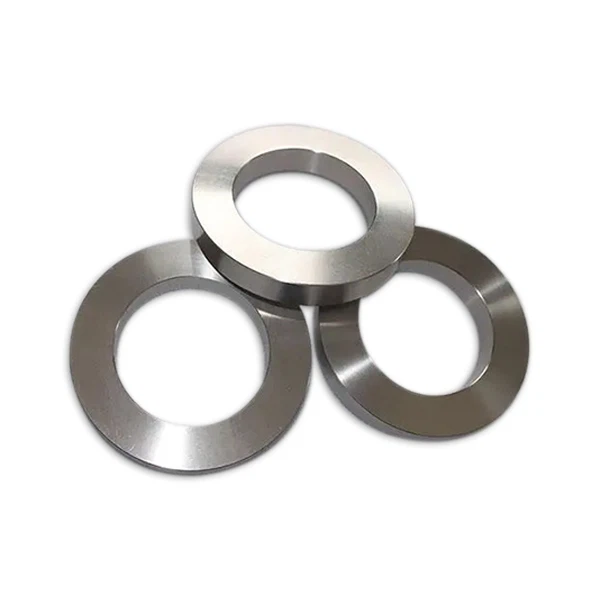
Titanium forged ring also be called titanium cyclinders,it is made by forging. Titanium ring has thick wall thickness, height is less than it's diameter. Titanium forged rings can be used in petro, deep sea, or chemical pressure euqipments.
Titanium Alloy Forged Rings Types including titanium seamless rolled rings, forged rings, and casted rings.
The process for seamless rolled forged rings involves cutting a hole out of the forging material and rolling it into a thin ring. The rolled forged rings offer concentrically improved rings with smooth surfaces as compared to plate burn-outs, or butt welded rings.
Application of Titanium Alloy Forged Rings
Titanium Alloy Forged Rings widely used in oil drill pipe, oil exploration, oil drilling platform, vacuum coating pipe, mining equipment, coal chemical equipment, gas drilling equipment, such as high pressure resistance, wear resistance, corrosion resistance. etc.
Titanium Alloy Forged Rings Processing
Titanium Forged Ring's technique is heating billet and repeated upsetting and chamfering processing, and then die out of the center hole in the titanium Forged blank using tool expand the central hole then processing,finally semi-finished Titanium Forged Rings are ready to inspecting, packaging and shipping.
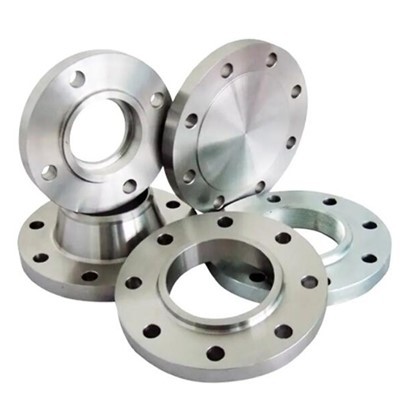
The purpose of titanium flanges is to connect different sorts of valves or pipes in a piping system. You create them using high-strength alloys. These materials provide excellent resistance to high temperatures and corrosion. From aerospace engineering to chemical processing, you can use them in many applications. We want to have a closer look here, then you can come to us for titanium forged and machined parts if you need them.
What is a titanium flange?
- A flange links two or more pieces of equipment or pipe together. Since they are made of titanium, you can use them in corrosive and harsh environments. Usually, they remain in place thanks to nuts and bolts.
- Another fact about flanges is that they come in a myriad of forms. Examples include weld neck, threaded, and socket weld. Depending on the application needs, every type comes with its own benefits and distinct features.
Slip-on flange
- The first style slips onto your pipe. You then weld it onto the neck of the fitting or pipe end. It offers a leakproof and strong joint. The flanges come with a slightly bigger diameter than the tube to help with this.
- Slip-on flanges are usually for low pressure jobs. They aren't difficult to install and you don't need to use special equipment or tools. As a result, they are popular for use in pipeline systems. They are not appropriate for high temperature or high pressure work though. They can lack the necessary strength for them.
Socket weld flange
- This is a sort of flange that is welded to the end of pipes to produce a leakproof, secure connection. The flanges possess a raised face as well as a socket-like end. It is one that fits over the pipe's end and gets welded in position. The joint between flange and tube is durable and strong, so you can use it in critical applications.
- The industries that make use of them include chemical, oil and gas, and petrochemical. If you need titanium forged and machined parts for these applications, we can provide them.
Blind flange
- Next is one that seals the end of a piping system or pipeline. It doesn't possess an opening, hence the name “blind” flange.
- Usually, these flanges are utilised in systems that demand shutdowns or isolation of pipeline sections. Furthermore, they are useful for testing system pressures during construction or maintenance. They can have various pressure ratings and sizes to match the particular application.
Lap joint flange
- This is a model that connects two fittings or pipes together. They are made up of two components. The first is the stub end; you weld it to the pipe. Then you have the backing flange to connect to another fitting or pipe using nuts and bolts. You can also easily remove these for repair or maintenance.
- It is common to use the lap joint flanges in low pressure applications. Also, they are suitable for piping set ups with regular reassembly and disassembly demands.
Weld neck flange
- This particular style is designed to be welded onto a pipe. It comes with a cylindrical bore, as well as a tapered, long neck.
- These flanges see extensive use in high pressure piping set ups. Here, they supply a leakproof and robust connection. People prefer using them over other models since they have superior durability and strength. In addition, thanks to the design they help distribute the pressure and stress evenly. This minimises the danger of damage and fatigue to the piping system.
Threaded flange
- Finally, is a style designed with interior NPT threads. They enable easy installation onto fittings or pipes. The threading also supplies a secure connection without you needing to solder or weld anything.
- It is possible to use threaded flanges with a myriad of pressure ratings and pipe size. You will find these in hydraulic, plumbing, and industrial systems.
Our Factory
Located in Baoji, Shaanxi province, known as China's Titanium Valley, Baoji West Titanium Materials Co., Ltd (West-Ti) was established in 2019 with a registered capital of 60 million yuan. The company was merged with Baoji Hongyuan Titanium Industry Co., Ltd. and Baoji Overflow Industrial Co., Ltd, both companies have more than 20 years of experience in the titanium industry. In 2019, the jointly established Baoji West Titanium Materials Co., Ltd business covers the processing and sales of rare metals such as titanium coil, plate, bar, wire, and titanium forging.


FAQ
As one of the most professional forging and stamping manufacturers and suppliers in China, we're featured by quality products and competitive price. Be free to buy forging and stamping for sale here and get quotation from our factory. Contact us for customized service.
