

Titanium fittings, also known as Ti fittings, are high-performance fittings made from titanium alloy. They are used in many industries, including aerospace, automobile, petroleum, and chemical, to connect and control the flow of liquids and gasses through pipes.




Why Choose Us
Advanced Equipment
Equipped with melting, forging, stamping, slitting, machining & CNC, we provide processes for the final products.
Rich Experience
With more than 20 years of experience, we achieve prosperity with our clients together.
Quality Control
From VIM to products, we control our quality from the ores.
One-stop Solution
More than 3,000 tons in inventory, and we deliver to our clients promptly.
Titanium fittings provide exceptional strength and durability while remaining lightweight. They are corrosion and oxidation-resistant so that they won't corrode even in harsh environments. The material is extremely flexible, too, making it suitable for various applications. Additionally, titanium has an excellent fatigue life, meaning the fittings can withstand high-pressure levels without breaking or deforming. It also stands well in extreme temperatures, from cryogenic to 2000°F (1093°C). This makes it ideal for aerospace applications where performance is key. All these features make titanium fittings the perfect choice for any project requiring long-lasting, reliable performance with minimal weight.

What are titanium fittings?
Titanium fittings are specialized parts designed to connect two components with a male or female connector. They come in a variety of sizes and shapes and are commonly used in aerospace, automotive, chemical, medical engineering and energy production.
Titanium is the preferred material for these accessories because of its exceptional strength-to-weight ratio, resistance to corrosion, and capability to endure extreme temperatures. Its non-magnetic properties and biocompatibility make it well-suited for applications that demand precise machining.
How do titanium fittings work?
Titanium fittings range from small threaded fittings to large pressure valves handling high-pressure or hazardous materials lines. Titanium fittings create a seal with an O-ring or compression fitting, providing a safe and secure connection between two devices.
Titanium is used in many sizes of pipes, tubes, hoses, pumps and more, making it ideal for harsh environments where steel may corrode or break due to wear and tear.
The Unique Properties of Titanium
A transition metal called titanium is known for its excellent qualities, which makes it a perfect material for a variety of purposes. Notably, titanium has an advantage over steel in terms of strength-to-weight ratio. Because of this quality, it is highly sought after in areas where lightweight and durable materials are crucial.
Additionally, titanium is known to resist corrosion even in the most extreme conditions, making it a reliable choice for applications exposed to moisture, chemicals, and high temperatures.
Advantages of titanium pipe fittings
Titanium pipe fittings offer numerous benefits in the oil and related industries. The material’s versatility allows for its application in various contexts.
Here are some of the reasons why titanium is widely used in different capacities:
The mechanical loading can be increased and the structural weight decreased by utilizing physical properties such as high strength and low density.
Additionally, its resistance to high temperatures, breakage, and non-magnetic nature make it well-suited for applications like marine risers, ultra-deep wells, tubing, and more.
These materials exhibit exceptional resistance to corrosion from various substances, including organic chemicals, acids, hydrogen, alkaline solutions, oxygen, sulfur dioxide, seawater, hydrochloric acid, sulfuric acid, phosphoric acid, nitric acid and anodizing treatments. Their robust structural integrity allows for prolonged usage and makes them a superior option for a multitude of purposes.
Titanium fittings are known for their cost-effectiveness due to their extended lifespan, minimizing the need for frequent replacements and eliminating the necessity of expensive reinforcements to enhance structural integrity. This durability makes titanium fittings an excellent choice across various industries, further complemented by their easy accessibility.
Applications of titanium pipe fittings
Titanium pipe fittings are widely used in various industries due to the unique properties of titanium. These properties include excellent corrosion resistance, high strength-to-weight ratio and biocompatibility. Here are some common applications for titanium fittings:
Aerospace Industry
The aerospace industry relies on materials that can withstand extreme temperature fluctuations and reduce overall weight. Titanium fittings excel in these areas, making them essential for hydraulic systems, fuel lines, and engine components in aircraft.
Chemical Processing
Titanium is an excellent choice for fittings used in chemical processing plants that handle corrosive fluids. Its corrosion resistance makes it a perfect match for these applications, effectively preventing pollution and ensuring the safety of both the environment and personnel.
Medical Equipment
Titanium is an exceptional material that is highly suitable for use in medical equipment, including implants, surgical instruments, and diagnostic devices. This is primarily due to its remarkable biocompatibility and outstanding resistance to biological fluids.
Marine Applications
Titanium fittings are a favored choice in the maritime industry due to their exceptional resistance to the corrosive nature of saltwater. This quality ensures that connections made with titanium fittings remain strong, reliable, and long-lasting in various marine applications such as ships, submarines, and offshore platforms.
Types of Titanium Fittings
Titanium pipe fittings are available in four main types: socket weld, threaded, compression, and flanged.
Socket weld fittings are a type of high-temperature fitting with an internal taper allowing for interference-free flow between the pipe and fitting; these are usually used in conduit systems and similar applications.
Threaded titanium fittings provide a tight seal through threads that compress against the pipe wall when tightened; these can be used in plumbing applications or industrial uses such as chemical processing.
Compression titanium fittings involve two sections that feature grooves that press together to form a watertight seal; they're primarily used for residential baseboard heaters and steam heating systems.
Finally, flanged titanium fittings utilize an outer lip that locks into place when assembled around a pipe; these require additional parts like bolts or gaskets to create high-pressure seals. The selection of each type of titanium fitting should be based on the specific needs of your application.

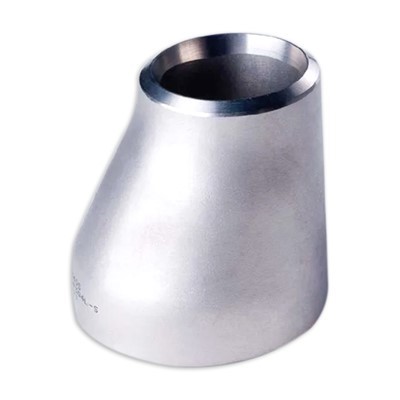
Titanium Industries carries a wide range of Grade 2 Titanium Concentric Reducer Pipe Fittings. Please find our available sizes below. Dimensional tolerances conform to ASME B16.9. Titanium Pipe Fitting wall thicknesses conform to standard schedule 10S and 40S ASME B36.19M wall pipe. Butt welding fittings are permanently marked by electro-chemical etching in accordance with ASME B16.9. Estimated Titanium pipe fitting weights are based on a density of 0.163 lbs/cubic inch.
Titanium Pipe Fittings and Titanium Grade 2 Concentric Reducer are significantly lighter than steel and have better corrosion resistances for applications within the Chemical Processing and other various Industrial applications. Grade 2 Titanium Concentric Reducer Fittings are available in schedule S10 and S40.
Titanium Grade 2 Concentric Reducer Pipe Fittings size range from 1.000" (25.4mm) x 0.500" (12.7mm) to 8.000" (203.2mm) x 6.000" (152.4mm).
How Is the Structure of the Titanium Elbow Properly Designed?
The titanium alloy elbow includes an elbow body. The two ends of the elbow body are respectively provided with a port 1 and a port 2.
The elbow body is sequentially composed of a titanium-based alloy layer, a sound insulation layer and an iron-based alloy layer from the inside to the outside. The thickness of the alloy layer is 2.5mm, the thickness of the sound insulation layer is 3.5mm, the thickness of the iron-based alloy layer is 4mm, and the bending angle of the elbow body is 155-165 degrees.
In order to make the product more reasonable, a dredging port is arranged at the bending part of the elbow body, and a sealing nut is threadedly connected to the outer end of the dredging port. Port 1 and port 2 are both provided with PTFE sealing rings. The outer walls of the first port and the second port are welded with connecting convex rings.
By adopting the above technical solutions, the structure i reasonable, the titanium-based alloy layer has high strength, is not easily deformed, has good corrosion resistance and has a long service life; The bending angle is set reasonably, the fluid flows smoothly, and it is not easy to be blocked.
In piping systems, elbows are pipe fittings that change the direction of the piping. According to the angle, there are three most commonly used ones: 45° and 90°180°, and other abnormal angle elbows such as 60° are also included according to engineering needs. Elbow materials include cast iron, stainless steel, alloy steel, malleable cast iron, carbon steel, non-ferrous metals and plastics.
Elbow use: It is a kind of connecting pipe fitting commonly used in pipeline installation. It connects two pipes with the same or different nominal diameters to make the pipeline turn at a certain angle. The nominal pressure is 1-1.6Mpa.
Properties of titanium elbow: Excellent strength, hardness, low density, light weight, high temperature resistance, low temperature resistance, good machining performance, and excellent corrosion resistance.
Good corrosion resistance
Titanium elbows work in humid air and seawater media, and their corrosion resistance is significantly higher than that of stainless steel, and they are stronger in pitting corrosion, acid corrosion and stress corrosion.
Good low temperature resistance
Titanium alloys can still maintain their mechanical properties at low temperatures.
High strength
The density of titanium alloy is generally about 4.51g/cubic centimeter, which is 60% of steel, and the specific strength (strength/density) of titanium alloy is much greater than that of other metal structural materials.
High heat intensity
The titanium elbow can be maintained for a long time at 450~500°C, and the strength is high, but the specific strength of the aluminum alloy is reduced at 150°C, the working temperature of the titanium alloy can reach below 500°C, and the working temperature of the aluminum alloy can reach 200°C the following.
The surface is smooth without scaling layer, and the scaling coefficient is greatly reduced
The strength of titanium pipe fittings is higher than that of high-quality steel, and it has good heat resistance, low temperature toughness and fracture toughness. Titanium products are mostly used as parts and structural parts of aircraft and titanium equipment.
Raw Materials for Manufacturing Titanium 45 ,90 Degree Elbows
Titanium or Titanium Alloy Elbows may be made from billets (ASTM B348), Titanium Plates (ASTM B265), Titanium Forgings (ASTM B381) and Seamless or Welded Pipe or Tube (ASTM B861 & B862). Forging, forming, or shaping operations may be performed by hammering, pressing, piercing, extruding, upsetting rolling, bending. fusion welding, or by a combination of two or more of these operations.
Titanium Elbow application
Titanium Elbow are Widely used in chemical, petroleum, metallurgy, light industry, power generation, water desalination, medical apparatus and instruments, alkali, salt, electroplating, coking, chemical fertilizer, etc.
Our Factory
Located in Baoji, Shaanxi province, known as China's Titanium Valley, Baoji West Titanium Materials Co., Ltd (West-Ti) was established in 2019 with a registered capital of 60 million yuan. The company was merged with Baoji Hongyuan Titanium Industry Co., Ltd. and Baoji Overflow Industrial Co., Ltd, both companies have more than 20 years of experience in the titanium industry. In 2019, the jointly established Baoji West Titanium Materials Co., Ltd business covers the processing and sales of rare metals such as titanium coil, plate, bar, wire, and titanium forging.


FAQ
As one of the most professional titanium fitting manufacturers and suppliers in China, we're featured by quality products and competitive price. Be free to buy titanium fitting for sale here and get quotation from our factory. Contact us for customized service.
