TA2 Titanium Tube - Performance Differences Resulting From Different Welding Methods
The TA2 Titanium Tubes, with their lightweight, high strength, high temperature resistance, and corrosion resistance, have become the core components of the fuel pipelines for the Long March series of launch vehicles and the pressure-resistant cabins of deep-sea exploration devices. WEST Ti has always adhered to the company's production philosophy of "quality assurance, customer first", and is committed to continuously improving the welding techniques of titanium and titanium alloys. By adopting different welding methods, it explores feasible paths to enhance the welding quality of the titanium tubes.
Four welding methods - Friction Stir Welding (FSW), Tungsten Inert Gas Welding (TIG), High Frequency Induction Welding (HFIW), and Laser Beam Welding (LBW) - can all be used for the connection of titanium and titanium alloy plates and rods, each with its own characteristics. However, in the specific field of titanium tube welding, the applicability of their processes and the influence laws on performance are still unclear. This article mainly shares our company's application of these four methods for welding TA2 titanium tubes, and the influence laws of different welding methods on the microstructure and mechanical properties of the welded tubes.
Take a 1.5mm thick TA2 titanium plate, whose chemical composition is shown in Table 1 and its microstructure is presented in Figure 1. As can be seen from Figure 1, the microstructure of the TA2 base material consists of equiaxed α phases, with grain sizes of approximately 40μm. The grain distribution is relatively uniform, closely arranged, and the grain boundaries are clear. Four welding methods, namely FSW, TIG, HFIW and LBW, were used to weld the pipe material, resulting in φ30mm×1.5mm TA2 titanium tubes. Figure 2 shows the schematic diagrams of the principles of the four different welding methods.

Table 1

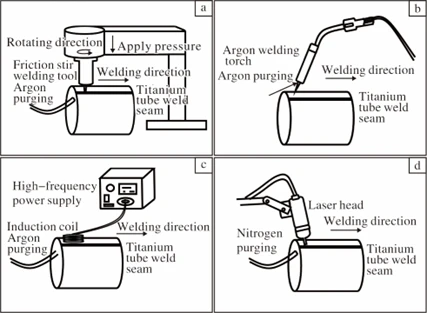
Figure 1 Figure 2
Figure 3 shows the macroscopic photos of TA2 titanium tubes welded by different methods. From Figure 3a, it can be seen that when using FSW, the pressure at the beginning of the welding was insufficient, resulting in incomplete penetration of the initial weld seam and rough surface; as the pressure increased, the surface of the subsequent weld seam became smooth, the fish-scale pattern was flat, and there were fewer burrs and spurs, with good quality. However, due to excessive frictional heating, the weld seam surface turned light gold. From Figure 3b, it can be seen that the TIG weld seam presents a gray-black color, which is due to insufficient protective atmosphere causing partial oxidation. From Figure 3c, it can be seen that the HFIW weld seam has complete fusion, straight and uniform weld beads, and good formation, but there are visible oxidation and peeling defects. From Figure 3d, it can be seen that the LBW weld seam is narrower, and the surface is bright and uniform, with no obvious defects. At the same time, the color of the surrounding base metal does not show any significant change, indicating that the heat affected zone is narrower compared to other welding methods and the inert gas protection effect is good.
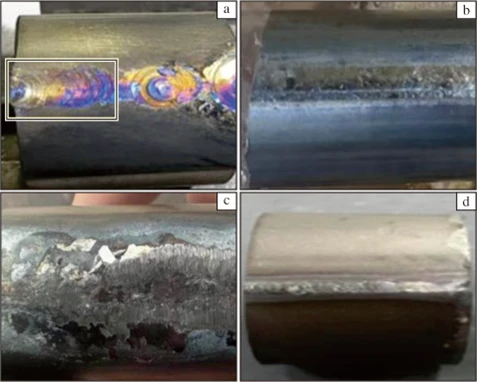
Figure 3
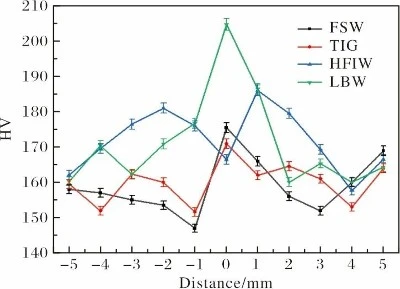
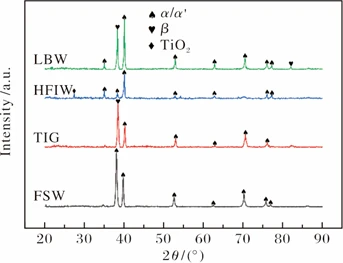
The FSW-welded TA2 titanium tubes have good weld formation, with a smooth surface free of defects. At the weld location, there are fine equiaxed α phases. The microhardness at the center of the weld is the highest, reaching 176.8HV. The grains in the heat-affected zone become coarse, and the microhardness is approximately 150HV. The cross-section after shearing presents a mixed fracture morphology of quasi-planes and intergranular fractures.
TIG can achieve welding of TA2 titanium tubes, but the weld surface is oxidized and appears grayish-black. At the weld area, there are coarse serrated α phases and point-like β phases. The microhardness is 171.0HV. The heat-affected zone has coarse grains, and the fracture surface of the cut is in a quasi- cleavage state.
The HFIW weld surface has oxidation and peeling defects. The weld area consists of equiaxed α phase. The microhardness at the weld center is the lowest. The heat affected zone is needle-shaped α′ martensite, with the highest microhardness. The fracture of the shear cut section is of cleavage type.
LBW can achieve high-quality welding of TA2 titanium tubes, resulting in a silver-white, smooth, and oxide-free narrow weld seam. At the weld seam, there is a fine needle-like α′ martensite + residual β phase, with a microhardness of 204.7HV. The heat-affected zone is a lamellar α′ martensite, and the cross-section is a quasi- cleavage fracture.
The above research presentation specifically cites the experimental data from Liu Zijian (2025) and other students. After being verified by the WEST Ti production department, if you aim for extremely high microhardness, LBW can be given priority consideration; if you aim for high metallurgical quality (low defects) and good comprehensive performance, FSW is recommended; if you need to control costs, HFIW can be chosen, but in this case, enhanced welding protection measures are required. The research presentation is for the reference of all technical engineers and purchasers. We welcome everyone to visit and place orders at WEST Ti.
【1】刘子健,陈文革,陈洋,高婷,成超超,余田亮. 不同方法焊接TA2钛管的组织与性能[J].钛工业进展,2025,42(6):29-36.