The Longitudinal Slitting Process Method For Titanium Plate
The longitudinal slitting and slitting methods for Titanium Plate and Titanium strips have unique technological processes and key operational points. Its feature lies in that for Titanium that have undergone uncoiling treatment, a complete process line method of "clamping - longitudinal shearing - directional material separation - pressing plate - slitting - coiling - uncoiling - packaging" is adopted for processing. By using this method, Titanium and Titanium alloy strip rolls with an opening length of up to several thousand meters can be longitudinally sheared, effectively removing the uneven edges of the Titanium strips. At the same time, according to the specific requirements of users, wide titanium strips can be precisely longitudinally sheared into multiple narrow titanium strips of different widths. Of course, it is also possible to simply trim the titanium strips to maintain their original width.
Clamping process
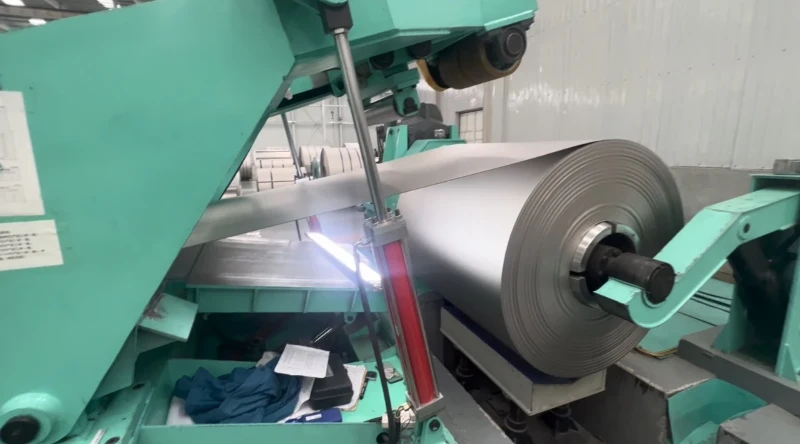
The Titanium belt in operation is clamped by a pair of rubber rollers and smoothly fed into the slitting machine. This step ensures the stable transportation of the Titanium strip during the subsequent processing, laying the foundation for precise longitudinal shearing.
Longitudinal cutting process
It is by means of a set of circular shears installed on a pair of horizontal rollers that the Titanium strips in motion are operated. The circular shears cut the Titanium strip longitudinally along its length into multiple narrow Titanium strips of different widths. Meanwhile, using the two pairs of circular shears on the outermost side, precisely cut off the uneven parts at the edges of the Titanium strip. The cut edge lines are wrapped by the collection wheel on the side of the circular shears to form edge line rolls, which is convenient for subsequent processing.
Directional fabric production process
The narrow Titanium strips separated by longitudinal shearing are guided by the distribution discs set on a pair of transverse rubber rollers. By reasonable setting, the same gap is maintained between adjacent narrow strips, allowing them to enter the pressing plate table in an orderly and neat manner, thus preparing for the subsequent pressing plate and winding processes.
Pressing plate process
It is by using the clamping function of the pressure plate table to accurately guide the cut narrow Titanium belt to the winding machine. This step ensures the directional stability of the narrow Titanium belt during the conveying process, avoiding any deviation or confusion.
Coil segmentation process
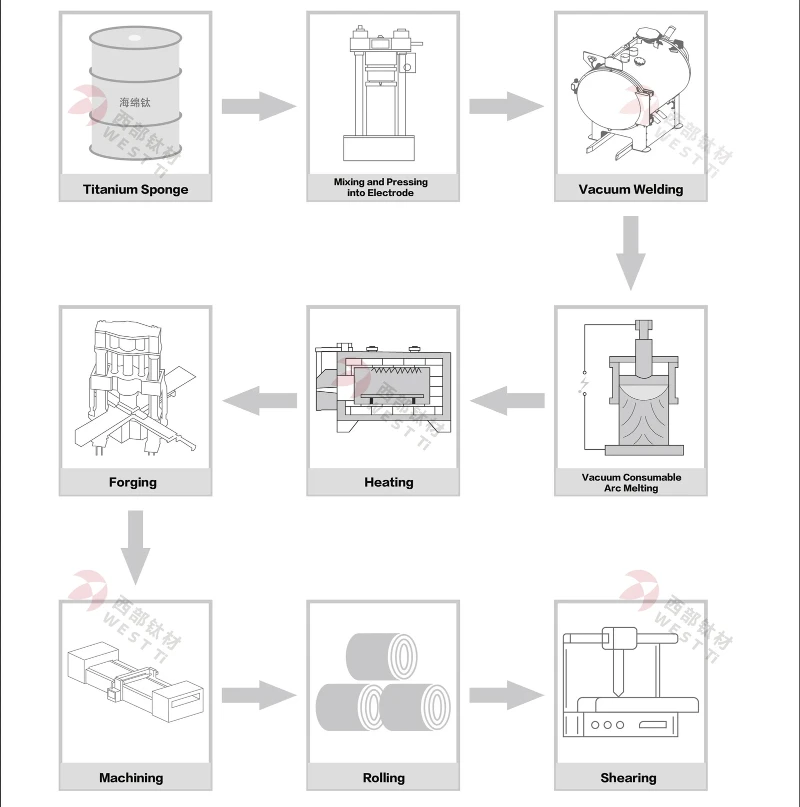
Coil splitting is the process of cutting titanium strips that have undergone longitudinal slitting and slitting into coils of different lengths based on actual needs, in order to meet diverse usage requirements.
Winding process
During the winding process, the narrow Titanium tape is guided by a set of directional distribution discs set above the core shaft of the winding device, enabling it to be wound into multiple narrow Titanium coils on the same core shaft. This winding method helps to improve the winding efficiency while ensuring the neatness and quality of the narrow Titanium coil.
Uncoiling process
When uncoiling, after all the narrow titanium strips have been coiled, the coiling trolley supports the titanium coils from below. Subsequently, the coiler contracted the expansion block, causing the inner ring core of the Titanium coil to loosen. Then, the operator manually bound and fastened the narrow Titanium coil with strapping tape. Afterwards, rotate the uncoiler steering platform beside the coiler to lead out the narrow Titanium coil from the coiler's core shaft. Rotate the unwinding steering table again to convey the narrow titanium coil to the packaging table for paper wrapping and packaging processing, completing the entire processing procedure.
Baoji West Titanium Material Co., Ltd.