Do you know how Large-Size Titanium Composite Plate being Prepared? And how about its Properties?
Technical tips for titanium composite plates
In the contemporary scientific community, a growing emphasis has been observed on the development of specialized processes for the fabrication of functional materials, which exhibit a diverse array of physical, chemical, and mechanical properties. Among these, the explosive welding technique merits particular attention due to its unique characteristics, which encompass diffusion welding, melt welding, and pressure welding.
The explosive welding technique has been demonstrated to possess a variety of materials with controllable sizes, superior interface bonding strength, and reprocessing performance. This versatility has led to its extensive utilization in diverse fields, including aerospace, nuclear power, and atomic energy, among others.
Products Description
Titanium possesses advantageous properties, including high strength and excellent corrosion resistance over a wide range of temperatures.In the context of preserving titanium resources, reducing equipment costs, enhancing equipment quality, and decreasing maintenance time, the employment of titanium composite plates has emerged as a prevalent practice in the domains of pure terephthalic acid preparation, oxidation reactors, solvent dehydration towers, and heat exchangers in the contemporary chemical and pressure vessel industries. Titanium composite materials, encompassing titanium and titanium alloys, exhibit high deformation resistance and low impact toughness, characteristics that pose significant challenges during processing. However, the adiabatic shear line emerges readily on the titanium layer following the explosive welding process, impeding the fabrication of large-scale composite plates, the enhancement of interface quality, and the optimization of performance.
The materials, explosives, and interface-forming mechanisms of small plates have been the focus of extensive research. However, the discrepancy in properties between the base and flyer materials gives rise to disparate explosive welding windows. However, the quality of the finished product often falls short of the standards established by explosive welding theory. The ripple of the bonding interface formed by explosive welding can directly affect the final quality of products, which is affected by many factors.
As the dimensions of composite plates are augmented, the uniformity of explosive composite and the stability of detonation wave during production are enhanced. Consequently, a greater duration is necessary to exhaust air at a constant detonation velocity during the manufacturing process. The complexity of process control is directly proportional to the severity of air exhaustion. Consequently, it is imperative to examine the interaction between titanium and steel when utilized in conjunction. During the explosion reaction, the superposition of the detonation wave and explosive products leads to an increase in pressure, as well as a decrease in stability, and the width of the plate. Consequently, the velocity and pressure of the detonation are pivotal factors in the fabrication of high-quality titanium composite plates.
Experimental summary of the preparation of Titanium Composite Plate
-
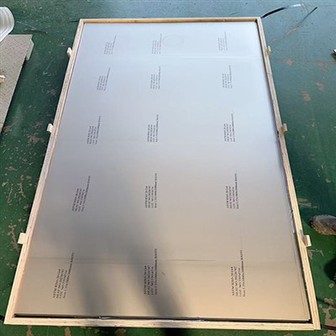
Titanium composite plates with dimensions of 4260 mm×4260 mm×(6.5+32) mm were prepared by means of explosive welding technique.A variety of analytical techniques, including ultrasonic nondestructive testing, phased-array waveform microscopy, optical microscopy, and scanning electron microscopy, were employed to assess the mechanical properties and interface morphologies of the composite plates.
-
The experimental findings indicate that when the detonation velocity, density, explosive height, and stand-off distance are set at 2200–2270 m/s, 0.80–0.82 g/cm3, 45.0–46.0 mm, and 8.0–11.0 mm, respectively, the mechanical properties of the prepared plates are found to meet the requirements stipulated in ASTM B898-2020.
-
The interface waveform displays a characteristic periodic combination morphology, with an interface that is clear and uniform. A modest quantity of solidified melt is present in the vortex area of the waveform. The ratio of amplitude to wavelength varies from 0.15 to 0.25, and the optimal shear strength can be attained when the ratio is approximately 0.20.