Advantages of One-Stage Periodic Titanium Slag Production Technology
Currently, titanium slag production with high TiO2 content (80% and more) has only proven to be feasible and economically viable in ore-thermal furnaces.
Single-stage production has several advantages over other methods of obtaining synthetic rutile. Two-stage one is more difficult as it involves reduction roasting and acid leaching, generates a significant amount of hazardous liquid waste, and requires higher financial investments. Melting synthetic rutile using a single-stage method is promising due to its economic viability (reducing production costs), the possibility of controlling the technological process, and the potential to obtain high-quality products.
Process Parameters of reduction smelting in ore-thermal furnaces
Types of charge for reduction smelting in ore-thermal furnaces
For a reduction smelting of ilmenite concentrate in ore-thermal furnaces, two types of charge mix are used – briquette and powdered.
For better use of the reductant, reduced dust emissions, and reduced specific energy consumption, working with a briquette charge is advantageous. However, difficulties arise due to the briquettes caking and their cementation by the boiling melt, which disrupts the permeability of the charge.
Therefore, a combined charge has also been developed in industrial practice, a mixture of briquettes and powdered charges. The ratio between them depends on the type of titanium concentrate. The content of powdered charge varies from 30 to 50%.
Briquettes are manufactured using roller presses, employing sulfide liquor as a binder.
Types of ore-thermal furnaces and requirements for them
For smelting titanium slags, three-electrode ore-thermal furnaces with transformers of the following power are used in the countries of the former USSR (Ukraine, Kazakhstan, Russia):
For better use of the reductant, reduced dust emissions, and reduced specific energy consumption, working with a briquette charge is advantageous. However, difficulties arise due to the briquettes caking and their cementation by the boiling melt, which disrupts the permeability of the charge.
Therefore, a combined charge has also been developed in industrial practice, a mixture of briquettes and powdered charges. The ratio between them depends on the type of titanium concentrate. The content of powdered charge varies from 30 to 50%.
Briquettes are manufactured using roller presses, employing sulfide liquor as a binder.
5 MVA with charging material quantity up 24 t;
16,5 MVA with charging up to 100 t;
25 MVA with charging up to 120 t.
Currently, such slags are smelted using open and closed ore-thermal furnaces in a batch process, which involves melting the entire charged material in the furnace and subsequent tapping of smelting products. The periodic nature of the process is driven by the need to obtain synthetic rutile with minimal iron oxides. To achieve this, a reductant is added to the furnace bath at the end of the smelting process. This operation is referred to as slag adjustment.
The periodic process in an open furnace, especially during the slag adjustment phase when the molten slag surface is not covered by solid charge, is accompanied by significant heat losses through escaping gases and radiation from the surface of the melt and the furnace walls.
The use of closed-roof ore-thermal furnaces for smelting slags significantly improves the technical and economic aspects of the process. It is because furnace productivity increases, specific energy consumption decreases, and losses of concentrate (due to the batch carry-over) with outgoing gases are reduced because of a lower amount of generated off-gases (several times less). Additionally, heat losses are reduced.
Several requirements are imposed on synthetic rutile smelting furnaces:
The furnace should have a relatively high specific power to enable rapid heating of the charge to a temperature around 900-1200°C without its significant melting and to maintain a liquid-flow state of highly viscous slags during the final stage of the process;
The electrode diameter and the rate of electrode consumption should be optimized to ensure the required concentration of thermal energy.
Specifications of a 25 MVA ore-thermal furnace
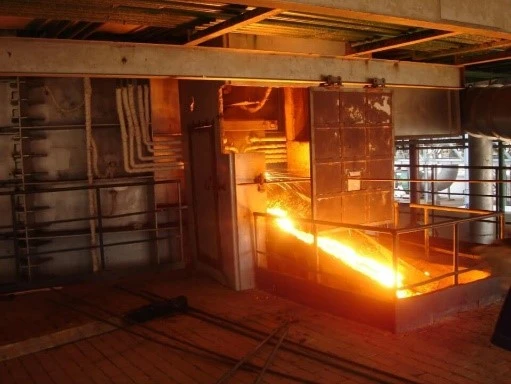
Characteristics of a 25 MVA OTF:
Type of electrodes – graphite electrodes;
Electrode diameter – 0,71 m;
Quantity of electrodes – 3 pcs.;
Quantity of transformers – 3 pcs.;
Transformer power – 8333 kVA;
Weight of charged concentrate for a melting operation – 120 t;
Furnace top – sectional, water-cooled;
Cooling medium – circulating process water;
Two tap-holes for separate tapping of synthetic rutile and associated metal.
Specifications of a reduction smelting process
Tapped titanium slag temperature – 1680 1760o C, that of the associated metal – 1470-1530o C. Titanium slag weight while tapping – max 18 t.
The technology provides:
Furnace production rate – 62627 t/year;
Titanium extraction from the concentrate with the dust recycling into commercial products (titanium slag) not less than 98%;
Production of titanium slag of a given composition;
Production of the associated standard metal.
Products obtained from smelting ilmenite concentrate in ore-thermal furnaces.
As a result of smelting ilmenite concentrates, titanium slags with TiO2 content ranging from 84% to 90% and FeO content ranging from 5% to 7% are obtained, depending on the composition of the initial concentrates.
As a rule, the chemical composition of titanium slags obtained from processing various concentrates and their mixtures undergoes minor variations. It is primarily determined by the completeness of the reduction reactions of iron oxides and the degree of re-reduction of titanium dioxide (TiO2) to lower oxides.
Titanium slag production technology makes it possible to produce them commercially, both for obtaining sponge titanium and for having titanium dioxide pigment using chloride or sulfuric acid methods.
Distribution of major elements between slag and cast iron during charge smelting can be assessed as follows:
Transfer to slag: titanium – 98.5%, iron – 3.5%, silicon – 72.0%. Part of the silicon evaporates as a lower oxide;
Transfer to cast iron: iron – 96-97%, titanium – 0.8-1.2%, silicon – 10-12%, vanadium – 45-48%.
Automation of the titanium slag smelting process
The objective of an automation system in the corresponding process is to control and stabilize process parameters of the charge preparation for smelting and to ensure uninterrupted operation of equipment and mechanisms according to a predefined program.
All processes of material transportation, loading and unloading, grinding, classification, dosing and mixing, briquetting, and drying are mechanized and automated.
Automation of the dosing system is designed to provide a rational rate of loading furnaces with a charge of a given composition, coordination, and control of the main parameters of charge materials dosing, their mixing, transportation, and supply to furnace hoppers.
The most significant influence on the ore-thermal furnace efficiency is the automatic control of the electric mode of the smelting process and electrode slipping. The corresponding process automation consists of automatic control of the furnace transformer cooling, water cooling of the furnace top, electrodes slipping, regulation of the top pressure, and other parameters.
Gas cleaning automation is a crucial factor for the smooth progression of the technological process, ensuring an efficient use of electrical energy and raw materials.
Looking for In-depth Engineering Expertise in the Titanium Slag Production Process to Improve It and Gain? Our Professionals are Here to Assist You.
Schedule a call
Peculiarities of the Titanium Slag Production Process
Guaranteed performance indicators of the proposed technology of titanium slag production in ore-thermal furnaces (OTF)
The proposed technology in ore-thermal furnaces (OTFs) provides for the following:
Furnace production rate- 62627 t/year;
Extraction of titanium from the concentrate with recycling dust into commercial products (titanium slag) – no less than 98%;
Producing titanium slag with a required composition – TiO2 content – 84-90% and FeO – 5-7%;
Production in the form of a commercial product, which can be used both for obtaining sponge titanium and for producing titanium dioxide pigment using chloride or sulfuric acid methods;
Production of associated metal;
Ensuring the process explosion safety and recovery of secondary energy resources.
An automated process control system (APCS) allows for the following:
To reduce smelting time by 3-5% due to mechanization and automation of dosing and furnace charging;
To reduce slag "boiling" due to uniform charging across the entire bath area of the furnace, to improve smelting conditions and process control;
Through automation of the electric smelting process, it's possible to increase the average hourly power pick-up by 7-9% and reduce smelting time by 6-8%;
To reduce specific power consumption rate by 50-100 kW per 1 ton of titanium slag and increase furnace production rate by 6-8%.
Summary (Conclusion)
Titanium slag is a high-demand product in the global market with a significant production volume characterized by a consistent and long-term growth trend.
It is a primary commercial product (semi-finished product) in the technological chain for obtaining titanium dioxide pigment, metallic titanium, titanium-based alloys, and highly processed products.
It is obtained from ilmenite concentrates in a single-stage method through reduction smelting in ore-thermal furnaces (OTFs).
Depending on ilmenite concentrates composition, titanium slags with TiO2 content ranging from 84% to 90% and FeO content between 5% and 7% are obtained due to the smelting process. These slags are considered commercial products.