Titanium slag production technology
Raw materials for titanium slag production
Titanium slag is obtained from ilmenite concentrates. Ilmenite is a natural mineral containing up to 52.8% titanium in terms of titanium dioxide.
Ilmenite is an association of titanium oxide with iron. Therefore, the first production stage aims to separate titanium dioxide from iron oxides. Ilmenite concentrate is reduced in ore-thermal furnaces (OTF) in the presence of a carbon-containing reductant (wood charcoal, anthracite, coke) to achieve this.
What are the Methods of Titanium Slag Production
Technological operations for titanium slag production
A modern, improved technology for titanium slag production through a single-stage method is proposed. This technology is completely ready for implementation.
The process of titanium slag production is the process of smelting ilmenite concentrate in arc ore-thermal furnaces (OTF) in a semi-closed mode with the use of a powder mixture to obtain titanium slag of a specified content of iron oxide, as well as associated metal.
The most important properties of titanium slags, which determine the reduction smelting process and the ability to fully separate iron and slag and their tapping from the furnace, are reliability, viscosity, and electrical conductivity.
Obtaining them by a one-stage periodic process includes the following technological operations:
Transportation, delivery, and storage of raw materials;
Preparation and charging of the mixture, consisting of ilmenite concentrate, reducing agent, and dust caught in cyclones, into the OTF;
Reduction of smelting of the mixture and obtaining a conditioned melt of slag and associated metal in the OTF;
Ladle pouring of slag and associated metal;
Ingot casting;
Ingot cooling;
Grinding and magnetic separation of titanium slag;
Desulfurization, alloying, and carbonization of associated metal;
Ingot pouring;
Delivery of titanium slag and associated metal to consumers;
Recycling of waste energy.
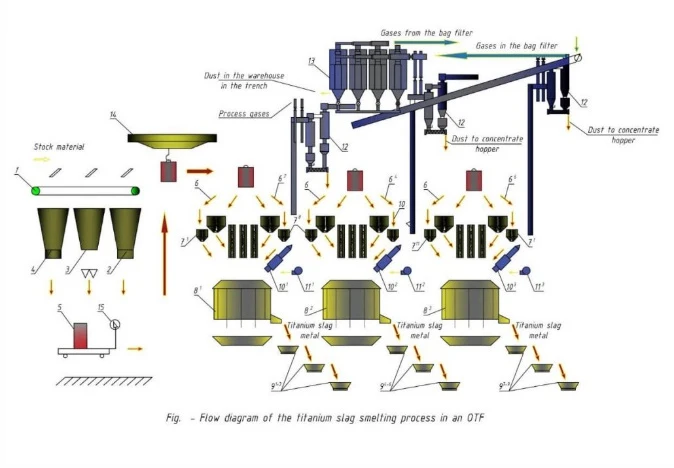
Process flow diagram of titanium slag smelting process
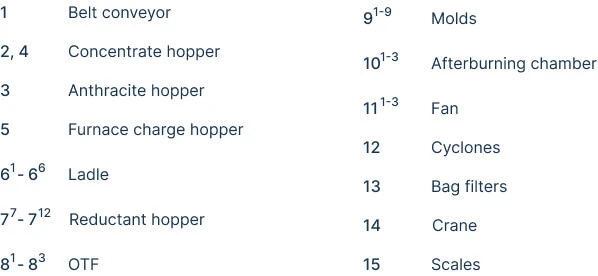
From loading hoppers, ilmenite concentrate and reductant are separately fed to dosing hoppers (position 2-4) through a system of belt conveyors (position 1). Components of the charge are dosed from the dosing hoppers in calculated quantities into a ladle (position 5) placed on a trolley on scales (position 15).
Filling furnace charge hoppers (positions 61-6) and the reductant hoppers (positions 77-12), used for slag adjustment, are carried out from ladles (position 5), which are transported using an overhead electric crane (position 14).
Charging the ore-thermal furnace (OTF) occurs from the furnace hoppers through a charging chute. Dust, captured in the cyclones of process GCP of the OTF, is fed into the furnace with the charge.
An afterburner chamber is provided for afterburning the reaction gases (pos. 101-3). Air is supplied to the afterburner chamber by fans (pos. 111-3).
Process gas extraction from the OTF is carried out through a system of gas ducts. Gases are cleaned from dust in cyclones (pos. 12) and bag filters (pos. 13).