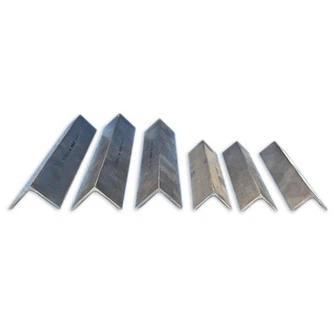
Gr5 Material (Ti-6Al-4V)
From Wikipedia, the free encyclopedia
Ti-6Al-4V (UNS designation R56400), sometimes called TC4, Ti64,[1] or ASTM Grade 5, is an alpha-beta titanium alloy with a high specific strength and excellent corrosion resistance. It is one of the most commonly used titanium alloys and is applied in a wide range of applications where low density and excellent corrosion resistance are necessary such as e.g. aerospace industry and biomechanical applications (implants and prostheses).
Studies of titanium alloys used in armors began in the 1950s at the Watertown Arsenal, which later became a part of the Army Research Laboratory.[2][3]
It is the most commercially successful titanium alloy and is still in use today, having shaped numerous industrial and commercial applications.[5]
Increased use of titanium alloys as biomaterials is occurring due to their lower modulus, superior biocompatibility, and enhanced corrosion resistance when compared to more conventional stainless steels and cobalt-based alloys.[6] These attractive properties were a driving force for the early introduction of α (cpTi) and α+β (Ti-6Al-4V) alloys as well as for the more recent development of new Ti-alloy compositions and orthopedic metastable b titanium alloys. The latter possess enhanced biocompatibility, reduced elastic modulus, and superior strain-controlled and notch fatigue resistance.[7] However, the poor shear strength and wear resistance of titanium alloys have nevertheless limited their biomedical use. Although the wear resistance of b-Ti alloys has shown some improvement when compared to a#b alloys, the ultimate utility of orthopedic titanium alloys as wear components will require a more complete fundamental understanding of the wear mechanisms involved.
Chemistry
[edit]
(in wt. %)[8]
|
V |
Al |
Fe |
O |
C |
N |
H |
Y |
Ti |
Remainder Each |
Remainder Total |
|
|
Min |
3.5 |
5.5 |
-- |
-- |
-- |
-- |
-- |
-- |
-- |
-- |
-- |
|
Max |
4.5 |
6.75 |
.3 |
.2 |
.08 |
.05 |
.015 |
.005 |
Balance |
.1 |
.3 |
Physical and mechanical properties
[edit]
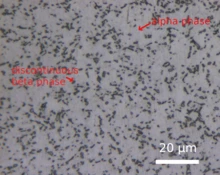
One possible microstructure of Ti-6Al-4V alloy with equiaxed alpha grains and discontinuous beta phase
Ti-6Al-4V titanium alloy commonly exists in alpha, with hcp crystal structure, (SG: P63/MMC), and beta, with bcc crystal structure, (SG: Im-3m) phases. While mechanical properties are a function of the heat treatment condition of the alloy and can vary based on properties, typical property ranges for well-processed Ti-6Al-4V are shown below.[9][10][11] Aluminum stabilizes the alpha phase, while vanadium stabilizes the beta phase.[12][13]
|
Density |
Young's Modulus |
Shear Modulus |
Bulk Modulus |
Poisson's Ratio |
Tensile Yield Stress |
Tensile Ultimate Stress |
Hardness |
Uniform Elongation |
|
|
Min |
4.429 g/cm3 (0.160 lb/cu in) |
104 GPa (15.1×10⁶ psi) |
40 GPa (5.8×10⁶ psi) |
96.8 GPa (14.0×10⁶ psi) |
0.31 |
880 MPa (128,000 psi) |
900 MPa (130,000 psi) |
36 Rockwell C (Typical) |
5% |
|
Max |
4.512 g/cm3 (0.163 lb/cu in) |
113 GPa (16.4×10⁶ psi) |
45 GPa (6.5×10⁶ psi) |
153 GPa (22.2×10⁶ psi) |
0.37 |
920 MPa (133,000 psi) |
950 MPa (138,000 psi) |
-- |
18% |
Ti-6Al-4V has a very low thermal conductivity at room temperature of 6.7 to 7.5 W/m·K,[14][15] which contributes to its relatively poor machinability.[15]
The alloy is vulnerable to cold dwell fatigue.[16][17]
Heat treatment of Ti-6Al-4V
[edit]

Ti-6Al-4V is heat treated to vary the amounts of and microstructure of α and β phases in the alloy. The microstructure will vary significantly depending on the exact heat treatment and method of processing. Three common heat treatment processes are mill annealing, duplex annealing, and solution treating and aging.[18]
Applications
[edit]
Aerospace structures. The Boeing 787 is 15% titanium by weight,[19] and the Airbus A350 is 14%.[20]
Biomedical implants and prostheses[21]
High-performance race cars
High-end bicycles
Additive manufacturing[22]
Apple iPhone 15 Pro (Max) case, iPhone 16 Pro and Pro Max cases, and Apple Watch Series 10 titanium and Ultra 2 cases
Marine applications: Ti-6Al-4V Grade 5 is extensively used in marine applications due to its exceptional corrosion resistance in seawater environments.[23] Ti-6Al-4V is applied in components exposed to marine atmospheres and underwater conditions, such as shipbuilding, offshore oil and gas platforms, and subsea equipment.[24][25] Its resistance to corrosion helps in reducing maintenance costs and extending the lifespan of marine equipment. [26]
Specifications
[edit]
UNS: R56400
AMS Standard: 4928[27]
ASTM Standard: F1472
ASTM Standard: B265 Grade 5[28]