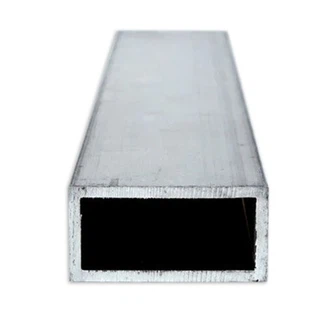
Titanium Heat Exchangers
What are the different types of heat exchangers?
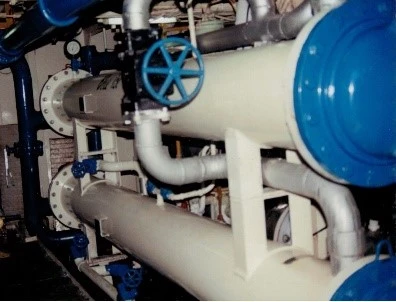
Heat exchangers come in two configurations, Shell & Tube and Plate & Frame. For Sea Water service, the Shell & Tube heat exchanger is the best and most reliable option. They can handle marine growth, debris, silt, and sand much better than a Plate & Frame unit. Plate & Frame exchangers tend to plug off with sand, silt, and marine growth because the plates are 'stacked' in a very tight sandwich with very small passages. Cleaning a Plate & Frame unit is a tedious process and may require an expensive set of new rubber gaskets. Shell & Tube units are easily cleaned with a water lance and do not require new gaskets when they are re-assembled. Cleaning generally takes less time and is contained in a small area in the engine room.
Sea Water is corrosive to most metals, except for Titanium. Copper-nickel, Brass, Stainless, and Carbon steel don't last due to the corrosive and erosive environment.
Mechanically, Titanium is very tough and is the ideal material for all seawater or exhaust gas applications. Call today to learn more about our shell & tube marine heat exchangers!
Other Titanium based product applications
Oil & Fuel Coolers: Cooling the fuel and lube oil on a ship extends engine life and maintains performance. Today's fuel circulation systems require a proper cooling system in order to keep the engine firing properly.
Exhaust Gas Elbows: Environmental pollution is becoming a very important topic in the marine industry. A ship's air pollution can be reduced by cooling the exhaust gases from the engines and boilers. Cooling the exhaust gases reduces NOx emissions, delivering a lower pollution signature. Capturing the waste heat can often be used for energy needs in the vessel accommodations.
Lithium Battery Cooling: New Hybrid and Battery Electric propulsion systems also create a lot of heat when charging and using Lithium batteries. Specialty Titanium heat exchangers can transfer this heat to the ocean while keeping the batteries cool.
RSW: Refrigerated sea water (RSW) systems use both Flooded or Direct Expansion (DX) chillers for cooling the fish. The "Sales Value of the Catch" is dramatically extended if the fish can be cooled very quickly. Titanium chillers work well in cold brines and won't plug with fish entrails, scales, and fins because large-diameter tubes can be used. Both Freon and Ammonia refrigerants are suitable for use with Titanium chillers and condensers.
Specifications:
Titanium Shell & Tube heat exchangers can withstand both high pressures and temperatures and vary according to the specific application.
Pressures: Up to 750 psig
Temperature: -20F to 500F
Acids: High resistance to all types
Sizes: 4″ dia to 30″ dia
Titanium's attractive properties and inherent corrosion resistance are due to its adherent protective oxide film that is chemically stable over a wide range of applications, from highly oxidizing to mild conditions. Because of these favorable qualities, Titanium alloys are usually expected to resist most natural water conditions and common salt solutions, chlorides, sulfates, silicates, phosphates, nitrates, carbonates, and others that have a pH range of 3-12. When compared to Stainless steel, Titanium does not demonstrate the same susceptibility to stress corrosion from chlorides, making the material well-suited for seawater, brine applications, and other similar instances.