

UT and PT methods in titanium manufacturing
The ultrasonic test is a sound-based method that can detect internal defects of welded parts, such as pores, cracks, inclusions, and pores. By measuring the relative change signal and amplitude, ultrasonic detection can be used to measure the size of the material or weld defects or attenuation. The basic idea behind ultrasonic detection is to use ultrasonic propagation speed and reflection mode in various materials to detect defects.
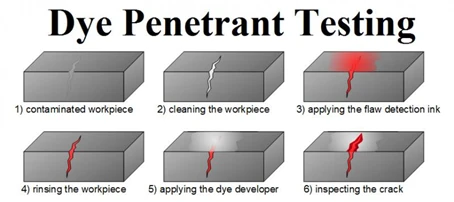
Penetrant test (PT) is a vision-based test method, which is suitable for detecting surface defects such as cracks, inclusions, and burrs.
Spray the dye Penetrant evenly on the welding surface, and let it sit for ten to fifteen minutes before cleaning it. Then the developer is applied, left on for seven to ten minutes, and applied thinly and evenly. More than 1000Lx of white light illumination is required to detect flaws through microscopic or visual tests.
Comparison of the advantages and disadvantages of PT and UT
Disadvantages of Penetrate test.
PT processes are more troublesome, and only surface defects can be detected, the deep defects cannot be found.
Advantages and disadvantages of Ultrasonic test.
Ultrasonic tests can detect internal defects of welded parts with higher accuracy, depth, and reliability. However, Ultrasonic test requires professional technicians and expensive equipment, and the cost is high.
In the production process of titanium materials, PT and UT are common non-destructive testing methods. PT mainly detects surface cracks and burrs and other defects, while ultrasonic detection can detect high-precision defects inside the welding, with higher accuracy, depth, and reliability. In practical applications, the appropriate detection method can be selected according to the situation to ensure that the product meets customer requirements.


