

Titanium Forged Ring: Material, Process & Quality Explained
Titanium Forged Ring: Comprehensive Disclosure of Material Properties, Manufacturing Process and Quality Inspection
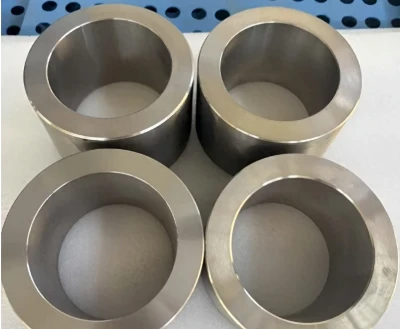
Titanium ring, also known as titanium forged ring or titanium alloy ring, is typically made of industrial pure titanium or titanium alloys through processes such as forging, ring rolling, and machining.
Selecting materials with wisdom:
Adapt to different working conditions. Pure titanium: The preferred choice for forming and corrosion resistance, such as TA1 (Gr1), TA2 (Gr2), etc., has excellent forming properties, weldability and corrosion resistance. In media with increasing oxidation strength (Gr1 < Gr2 < Gr3), pure titanium shows good adaptability and is often used to make shaped seals. Take the chemical industry as an example, in some environments with high requirements for sealing and moderate corrosiveness of the medium, pure titanium forged rings can precisely fit the sealing parts thanks to their excellent forming properties. Meanwhile, on the surface of the titanium ring, a 5 - 20nm dense TiO₂ passivation film will form in the oxidative medium, which acts like a solid "armor" and remains stable in the pH range of 1 - 14. Its excellent corrosion resistance ensures long-term stable use and reduces the risk of leakage caused by corrosion. Titanium alloy: The combination of high strength and adjustable performance. Titanium alloy represented by (Gr5) TC4 (Ti - 6Al - 4V) is a high-strength alloy. It maintains good corrosion resistance while having a strength far exceeding industrial pure titanium, with a strength greater than 895MPa. Moreover, Gr5 titanium alloy can be adjusted in performance through heat treatment to meet the needs of different working conditions. Industrial pure titanium can work stably at temperatures below 150°C, while the long-term working temperature of Gr5 alloy can reach 400°C, and the short-term peak temperature is even higher. However, its weldability is slightly inferior to pure titanium.
Crafting Excellence: Multi-stage High-Precision Engineering
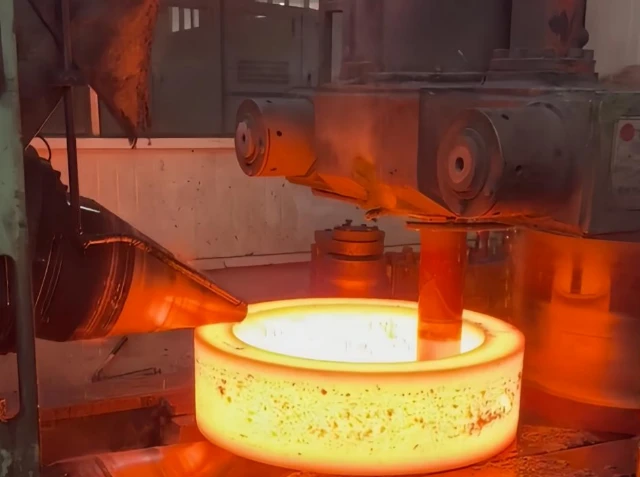
The manufacturing process of titanium forgings is a multi-stage, high-precision engineering that integrates material science, thermodynamic control, and precision processing technology. Taking our company WEST Ti's experience in manufacturing titanium forgings as an example, the core process is as follows:
1.Titanium ingot VAR: Through the vacuum self-consuming arc remelting (VAR) technique, the titanium raw material is refined to remove impurities, thereby enhancing the purity and quality of the titanium ingot.
2. Rough forging: The titanium ingot is subjected to rough forging to break the cast structure, improve the internal structure of the ingot, enhance its uniformity and density, and improve the mechanical properties of the material.
3. Blank Making: This process involves operations such as roughing and punching, which further shape and size the forged billet to match the requirements for ring rolling.
4. Ring Rolling: This is the key process for obtaining ring-shaped components. Through ring rolling, the billet is expanded and shaped to produce a ring-shaped titanium forging ring that meets the design requirements.
5. Heat treatment: Depending on the different types of titanium alloys and usage requirements, various heat treatment processes such as annealing or solution aging are carried out to adjust the microstructure and properties of the titanium forging rings, thereby enhancing their strength, hardness, and toughness, etc.
6. Machining: Using methods such as grinding, drilling, and turning, the titanium forged rings processed after heat treatment are made to the final size, ensuring that their dimensional accuracy and surface quality meet the standard requirements.
7. Surface treatment: Conduct surface treatment processes such as acid washing and passivation to further enhance the corrosion resistance of the titanium forging ring and improve its surface appearance.
8. Non-destructive and Performance Inspection: This is the final stage of the manufacturing process, where non-destructive testing is conducted on the titanium forged rings, such as eddy current testing, ultrasonic flaw detection, etc. A 100% comprehensive inspection process is carried out to achieve traceability of manufacturing process data. It also includes chemical composition analysis, mechanical property tests, etc. At the same time, the microstructure and surface quality are inspected, requiring no cracks, folds, etc. The surface needs to be ground and chamfered to ensure the quality reliability of the titanium forged rings. The standards are strict: The production and acceptance of titanium forged rings follow a strict standard system. The core standard is "GB/T16598 - 2013 Titanium and Titanium Alloys Sheets and Rings", which is applicable to hot forging and hot rolling titanium rings.
Future Outlook:
In the future, with the deep integration of 3D printing technology in the titanium alloy manufacturing field, the customized production of titanium forged rings will witness a new leap forward. 3D printing technology can directly manufacture complex-shaped titanium forged rings based on individualized requirements under various complex working conditions, eliminating multiple processing steps in traditional manufacturing processes, thereby enhancing production efficiency and product quality, and meeting the application needs of more specialized fields.


